Montages are specific arrangements of electrode pairs (channels) used to record EEG signals.
A channel is defined as the voltage difference between two electrodes (e.g., Fz-Cz).
Referencing in EEG
Referencing is the process of choosing a reference electrode (or combination of electrodes) to measure voltage differences.
Voltage waveforms are reference-dependent: The same brain activity will look different depending on the reference used.
Analysis results depend on the reference: Incorrect referencing can distort or obscure true brain activity.
Common EEG References
Reference Type
Description
Pros
Cons
Average Reference
The average of all electrodes is used as the reference.
Reduces bias from a single electrode.
Sensitive to artifacts in any channel.
Linked Mastoids
The average of the mastoid electrodes (behind the ears) is used as the reference.
Reduces muscle artifacts.
May not capture global brain activity.
Bipolar
Voltage difference between two adjacent electrodes (e.g., Fp1-F7).
Highlights local activity.
Loses global context.
Laplacian
A weighted average of surrounding electrodes is subtracted from the central electrode.
Enhances local activity.
Computationally intensive.
Common Mode Rejection
Uses differential amplification to reject noise common to both electrodes in a pair.
Reduces environmental noise.
Requires high-quality hardware.
Why Referencing Matters
Voltage waveforms are ambiguous: The same neural activity can appear differently depending on the reference.
Topography is reference-independent:
The shape of the topographic map (e.g., scalp distribution of activity) remains the same regardless of reference.
Only the reference level (baseline) may shift (e.g., changing sea level doesn’t change the shape of a map).
Topography is neurophysiologically interpretable and unambiguous for comparing conditions.
No Reference-Free Information
Differential amplification: EEG systems measure the difference between two electrodes.
Absolute potential is unknown: The true potential at any single electrode cannot be measured because both electrodes pick up brain and body signals via volume conduction.
Implications: All EEG data is relative, and the choice of reference affects the interpretation.
Montages as Spatial Filters
Montages act as spatial filters, emphasizing or suppressing certain types of activity:
Localized Montages (e.g., bipolar):
Better for detecting focal, coherent activity (e.g., epileptic spikes in a small brain region).
Filter out widespread waveforms (e.g., global artifacts or slow waves).
Widespread Montages (e.g., average reference):
Better for detecting generalized activity (e.g., global alpha rhythms).
Can be sensitive to widespread artifacts if not cleaned properly.
Practical Implications
Artifact Removal First: Since referencing (e.g., average reference) uses data from all channels, remove artifacts from all channels first to avoid propagating artifacts across the entire dataset.
Topographic Maps: Use topographic maps for reference-independent interpretations of brain activity.
Montage Selection: Choose a montage based on your research question:
Focal activity? Use bipolar or Laplacian montages.
Global activity? Use average or linked mastoids references.
Definition: Estimates a theoretical zero-reference using a forward model of the head’s volume conduction.
Use Case:
Research requiring reference-free interpretations (e.g., source localization).
Pros:
Approximates absolute brain activity.
Reduces reference bias.
Cons:
Computationally intensive.
Requires accurate head model.
Laplacian Referencing
Definition: The reference is a weighted average of neighboring electrodes (e.g., 4 closest electrodes).
Use Case:
Highlights local activity (e.g., motor cortex in BCI).
Pros:
Enhances spatial resolution.
Reduces volume conduction effects.
Cons:
Loses global activity.
Sensitive to electrode density.
Weighted Average Referencing
Definition: The reference is a weighted average of all electrodes, with weights based on distance or other criteria.
Use Case:
Custom analyses where specific electrodes should contribute more/less.
Pros:
Flexible and adaptable.
Can reduce bias from distant electrodes.
Cons:
Requires careful weight selection.
Computationally complex.
Bipolar Referencing
Bipolar referencing is a powerful technique for highlighting localized brain activity and reducing artifacts.
Measures the voltage difference between two adjacent electrodes (e.g., F4-C4, C4-P4).
No common reference electrode is used; each channel is defined by a pair of electrodes.
Types of Bipolar Montages
A. Longitudinal (Anterior-Posterior) Bipolar Montage
Definition: Electrodes are chained from front to back (e.g., Fp2-F8-T8-P8-O2).
Use Case: Detecting activity along the anterior-posterior axis (e.g., tracking the propagation of epileptic spikes).
Example: Fp2-F8, F8-T4, T4-T6, T6-O2
B. Transverse Bipolar Montage
Definition: Electrodes are chained side-to-side (e.g., F7-F3-Fz-F4-F8).
Use Case: Detecting lateralized activity (e.g., comparing left vs. right hemisphere activity).
Advantages of Bipolar Referencing
Localized Activity: Excellent for detecting low to medium amplitude, highly localized potentials (e.g., focal epileptic spikes).
Artifact Reduction: Less prone to artifacts because it measures differences between adjacent electrodes, canceling out common noise.
Versatility: Can be adapted to various electrode arrangements (e.g., longitudinal, transverse, circumferential).
Phase Reversal
Phase reversal is a key concept in bipolar referencing that helps localize the source of brain activity.
How It Works:
When a source (e.g., an epileptic spike) is close to an electrode, the voltage changes polarity across adjacent bipolar channels.
This creates a characteristic pattern:
Positive Phase Reversal: Source is positive: small upward deflection → large upward deflection → large downward deflection → small downward deflection.
Negative Phase Reversal: Source is negative: small downward deflection → large downward deflection → large upward deflection → small upward deflection.
Example:
Suppose a source near T4 generates the following potentials:
Phase reversal occurs between F8-T4 and T4-T6, indicating the source is closest to T4.
Common Bipolar Montage Chains
Temporal Chains
Left Hemisphere: Fp1-F7 → F7-T3 → T3-T5 → T5-O1
Right Hemisphere: Fp2-F8 → F8-T4 → T4-T6 → T6-O2
Parasagittal Chains
Left Hemisphere: Fp1-F3 → F3-C3 → C3-P3 → P3-O1
Right Hemisphere: Fp2-F4 → F4-C4 → C4-P4 → P4-O2
Central Chains: Fz-Cz → Cz-Pz
End of Chain Phenomenon
Issue: If the source is located close to the first or last electrode in a bipolar chain (e.g., Fp2), the phase reversal pattern may be incomplete or misleading.
Solution: Use a circumferential montage to create a closed loop of electrodes, ensuring the source is never at the “end” of a chain.
Use Case: Good for general, distributed brain activity.
Example Montages: F3-Cz, F4-Cz, etc.
Pros: Centrally located, less prone to lateralized artifacts.
Cons: May not be ideal for focal activity detection.
Auricular (A1/A2)
Use Case: Commonly used for clinical and research EEG.
Example Montages: F4-A1, C4-A2, etc.
Pros: Easy to place, widely accepted.
Cons: A1 often contains more ECG artifacts than A2. Auricular references can introduce lateralized biases.
Mastoid (M1/M2)
Use Case: Preferred for many research applications, especially when using linked mastoids.
Example Montages: Linked mastoids (M1+M2), or ipsilateral/contralateral referencing.
Pros: “Relatively silent” (less electrical activity), good for distributed activities.
Cons:
Single Point of Failure: Poor contact can introduce significant noise and contaminate data.
Proximity to Brain: May pick up temporal signals, which can be a pro or con depending on the study focus.
Not Ideal for Focal Activity: Less sensitive to localized brain activity.
Best Practices
Linked Mastoids: Often recommended for reducing noise and lateralization effects.
Monitor Contact Quality: Regularly check electrode impedance, especially for mastoid references, to avoid signal contamination.
Consider Study Goals: Choose the reference based on whether you are studying distributed or focal brain activity.
Common Average Reference (CAR)
How It Works
Mechanism: All electrode signals are averaged and subtracted from each channel.
Principle: “All potentials sum to zero.”
Exclusion Rule: The current electrode is excluded from its own average calculation to avoid artificial suppression.
Advantages
Reduces Reference Contamination: Minimizes the risk of a single noisy electrode skewing the entire recording (e.g., if one electrode is highly negative).
Mitigates Single-Point Failure: Less vulnerable to poor contact at one electrode compared to mastoid or ear references.
High Amplitude: Less phase cancellation between input signals, preserving waveform amplitude.
Versatility: Effective for broadly distributed or generalized electrical fields (e.g., widespread epileptic activity).
Limitations
Artificial Coupling: Introduces a “waterbed effect,” where activity in one region can artificially suppress or amplify activity elsewhere.
Susceptibility to Outliers: A single noisy or outlier channel (e.g., due to poor contact or artifact) can contaminate the average. Solution: Detect and remove bad channels before applying CAR.
Not Ideal for Focal Activity: Poor spatial resolution for localized brain activity.
Does Not Filter Widespread Potentials: May not effectively isolate focal signals in the presence of global activity.
Practical Considerations
Exclude Problematic Electrodes: Omit Fp1/Fp2 (eye blink artifacts) and O1/O2 (head movement artifacts) from the average calculation.
Preprocessing: Always clean the data (e.g., remove bad channels) before applying CAR to avoid reference contamination.
Amplitude Localization: In referential recordings, the electrode with the highest amplitude defines the focus of activity (no phase reversals).
When to Use CAR
Best for: Studies of generalized or widespread brain activity (e.g., generalized seizures, global brain states).
There is no phase reversal and as such, the highest amplitude waveform is the one with the greatest voltage, be it downward or upward. In referential recording, the localization principle is amplitude. That is, the electrode recording the greatest amplitude of the wave in question defines the focus.
Laplacian Reference
Definition
The Laplacian reference re-references each electrode against the weighted average of its neighboring electrodes, e.g. \(Cz - 1/4 \times (Fz + C3 + Pz + C4)\).
\(Si\) is the set of electrodes surrounding the i-th electrode, and \(d_{ij}\) is the distance between electrodes \(i\) and \(j\) (where \(j\) is a member of \(S_i\)).
Advantages
Excellent for Focal Activity: Enhances spatial resolution by emphasizing localized brain activity.
Reduces Volume Conduction Effects: Minimizes the influence of distant or widespread signals, making it ideal for detecting focal sources.
Limitations
Poor for Generalized Activity: Not suitable for studying broadly distributed or generalized electrical fields (e.g., widespread epileptic activity).
Edge Effects: Electrodes at the edges (e.g., T7) cannot be symmetrically surrounded, requiring approximations (e.g., averaging fewer neighbors).
Variants of Laplacian Reference
Variant
Description
Use Case
Planar Laplacian
Subtracts 1/4 of each of the 4 surrounding electrodes (2D distance).
Simple, fast computations.
Spherical Laplacian
Uses 3D distances between electrodes, accounting for the curvature of the head.
More accurate for realistic head geometry.
Spatial Laplacian
Fits surface potential to a spline function and calculates spatial derivatives.
High precision for complex head models.
Realistic Head Model
Incorporates individualized head anatomy for precise spatial filtering.
Research requiring high spatial accuracy.
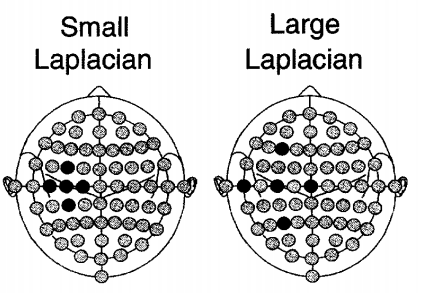
Size Variants
Small Laplacian: Uses the 4 nearest neighbors (adjacent electrodes).
Large Laplacian: Uses the next-nearest neighbors (4 electrodes beyond the adjacent ones).
Practical Recommendations
Use for Focal Activity: Ideal for detecting localized brain signals (e.g., ERP components, focal epileptic spikes).
Avoid for Generalized Activity: Not suitable for studying widespread brain states.
Handle Edge Electrodes Carefully: Use approximations (e.g., averaging 3 neighbors for T7) to mitigate edge effects.
Choose the Right Variant:
Use planar Laplacian for simplicity.
Use spherical or realistic head model Laplacian for higher accuracy in research settings.
Tip:exclude_fpo=true will exclude Fp1, Fp2 (due to eye blinks), O1, O2 (due to head movements) from CAR calculation.
Tip:exclude_current=true will exclude current channel from CAR calculation.
Referencing to ipsilateral auricular electrodes:
reference_a(eeg, type=:i)
Referencing to contralateral mastoid electrodes:
eeg_tmp =deepcopy(eeg)# we don't have mastoid channels, so let's pretendedit_channel!(eeg_tmp, ch ="A1", field =:label, value ="M1")edit_channel!(eeg_tmp, ch ="A2", field =:label, value ="M2")reference_m(eeg_tmp, type=:c)
Referencing using planar Laplacian:
eeg_lap =reference_plap(eeg, nn =4, weighted =false)plot_topo(eeg_lap, ch ="eeg", tpos =12, title ="Laplacian (4)")
eeg_lap =reference_plap(eeg, nn =6, weighted =true)plot_topo(eeg_lap, ch ="eeg", tpos =12, title ="Weighted Laplacian (6)")